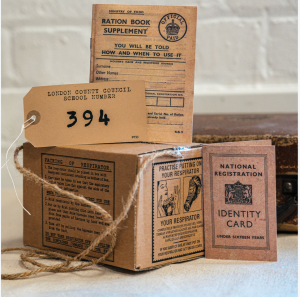
The Munich crisis came in March 1939. Neville Chamberlain, the U.K. Prime Minister, is principally remembered for appeasing Adolf Hitler, but he did also buy valuable time for Britain to prepare for war. British civilians in the London area were provided with gas masks well before hostilities began, because gas attacks were expected and greatly feared by all of the combatants. Our personal gas masks were issued and fitted in our local public library in Ilford in the summer of 1939 and the library basement was improvised as a public air-raid shelter. More public air-raid shelters were hurriedly built in our local urban streets. We were all issued with ration books and identity cards.
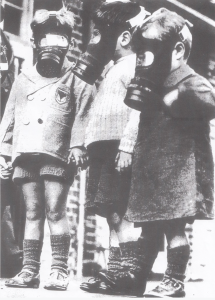
Left: British children with their government-issued gas masks in 1939; source
Right: Gas mask carrying box, ration book and identity card; source
Basic foods such as butter and sugar were rationed throughout the war, with some rationing even being continued until 1952. Identity cards were abolished at the end of the war being an infringement of personal liberty.
My stepfather volunteered to serve in the RAF barrage balloon service in April 1939, to help defend London from the anticipated low-level air attacks. He was released from the RAF in November 1939 to resume his important civilian role of selling vegetable seeds to farmers, so that vital food could be grown on British farms.
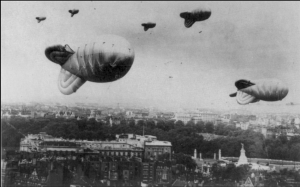
RAF barrage balloons deployed over London to defend against low-level air attacks; source
A week before war was officially declared in September 1939, my mother and I went briefly back to the family farm near Colchester, of course carrying our gas masks and identity cards. We went partly to escape the greatly feared gas attacks but also to occupy the family home that would otherwise have been requisitioned to house some of the many evacuees then pouring out of east London. Mercifully, neither side used poison gas in the entire war and after a short time we and all the official evacuees soon went back to London.
Nothing much happened on the Western Front between Germany and France for the next six months – a period dubbed as the ‘phoney war’. This relative calm ended with the German ‘blitzkrieg’ against Belgium and northern France on 10th May 1940 and the Battle of Dunkirk on 26th May. Neville Chamberlain resigned and Winston Churchill became the UK Prime Minister for the duration of the war. The country felt inspired by his leadership. His wartime speeches are rightly remembered for their rallying call to the British people, to continue the fight in what was dubbed by Churchill as ‘their finest hour’. Ordinary people realised the imminent peril we were in. The Battle of Britain was underway with German bombers strafing airfields in Kent to the south of us, in an attempt to ground our fighter planes. The phoney war was over. We did not see much of the action that summer in Essex, but I do recall seeing a dogfight between two fighter planes, one of which went down in flames. I do not know if it was one of ours or one of theirs. We listened avidly to the latest score in the air war on the wireless, with the RAF fighter planes outnumbered four to one by the Luftwaffe. In reality however, the number of planes in actual combat over Kent was fairly even, because the Germans had further to fly to the field of battle. Many of the RAF pilots were able to bale out safely over their own territory and quite a few of our damaged planes could be repaired. At one critical stage, the RAF had no reserves of fighter planes at all. But the British aircraft factories were now fully focused on war production thanks to Chamberlain, so that the numerical advantage of fighters swung in favour of the British. German fighters lost command of the air space over southeast England for good in September 1940. We owe a big debt of gratitude to RAF Fighter Command.
At this stage in the war, the invasion of Britain by Germany from France was considered imminent, with virtually no British army left in the field to defend the islands after the Battle of Dunkirk. The coastal area of south-east England was sealed off to non-residents to a width of 5 miles (8 km). Clacton Pier was blown in half, in case the Germans tried to land troops on it. (They didn’t). Beaches were impaled with barbed wire and mined. The LDV (Local Defence Volunteers), later called the Home Guard, prepared to defend their communities against German paratroopers. Anti-tank ditches were dug around London. My father took me to see one in Hainault Forest near Ilford early in the war. The anti-tank defenses were not tested until much later and were found to be totally ineffective.
In September 1939, we discovered that our local school buildings had been requisitioned as an auxiliary fire station. After a few weeks, our local primary school organised lessons for some of us twice a week in parents’ homes, to prepare for the 11+ tests in English, arithmetic and a general paper. This was colloquially known as the ‘Scholarship exam’. We were given lots of homework to keep us busy during the school week. In March 1940, we were allowed back into our old school buildings just for one day to take the 11+ tests (similar to Selective School tests today). We each had a new pencil (mine cost 4d), a rubber (eraser) and a ruler. Those who were selected for the two local high schools – Ilford County High schools for boys and girls respectively – then had a choice. This included me. We were told that we could either stay at home with our mothers and probably have no schooling at all for an indefinite period or be evacuated with our future high school to somewhere safe. Once the decision was made on my behalf for me to be evacuated, a completely new life opened for me. We were put on a train to South Wales in May 1940 to be billeted with local Welsh foster parents in the safety and security of the Welsh mountains. This life-changing episode in my childhood will be described next.
****************
My Life in WW2 during Evacuation
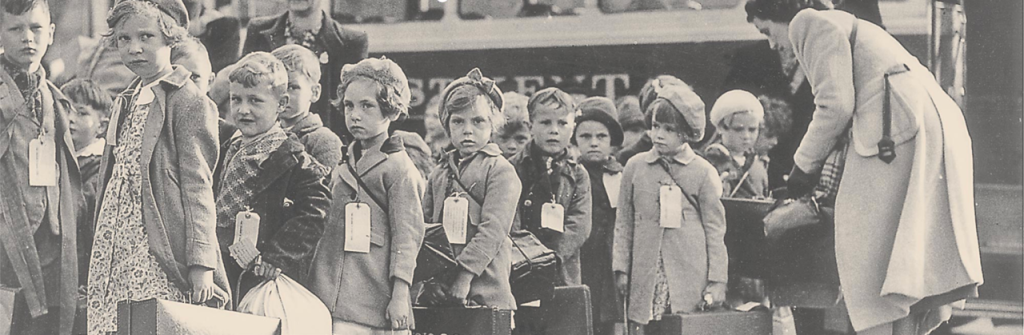
I vividly remember the day that we assembled for evacuation to Wales. My mother tied a large brown luggage label to my coat with my name and school on it. We climbed aboard an old steam train with our little cardboard suitcases. Our mothers kissed us tearfully goodbye. I was not yet eleven.

Evacuee children leaving London; source
The train steamed all day across England, then up the Taff and Dare valleys to Aberdare in Wales. We saw lots of exciting new things like hills and rivers and waterfalls. On arrival at Aberdare, we were crocodiled (walked in pairs in a long line) to a large hall and seated on long benches for local people to come and make their selection of evacuees. The chosen ones went off one by one to their new homes. It was rather like a cattle market with us as the cattle. Soon the hall began to empty, and I came to realise that I was one of only half a dozen waifs who had not yet been selected. This was undoubtedly one of the low points in my young life. I had a good sob, sitting on a cold bench in a draughty hall in a strange land. But the day ended happily. A kind lady named Mrs Bridget Evans felt sorry for me and said she would take me in. We walked home together hand in hand to number 12 Seymour Street, which was to be my happy home for the next fourteen months. The front door opened straight off the street. There was a fish and chip shop at the street corner.
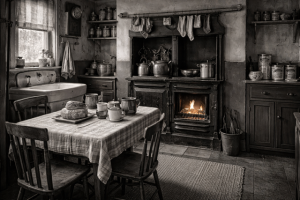
A typical Welsh working-class kitchen of the early 1940s
Mrs Evans, was a lady in her 50s. She had been a rural district nurse for many years, but she had given up her job through ill health. She was married to Mr John Evans, a solicitor’s clerk. I soon called them Mother and Pop. We lived in the kitchen with a big old-fashioned coal range. Coconut matting covering the slate floor. There was a large tabby cat called Peter. Mrs Evans made me Welsh cakes for tea, a delicacy of the house. They were delicious. A tiny bedroom had been prepared for me at the top of the stairs. The lavatory (toilet) was at the bottom of the garden. It was connected to the sewer but there was no flush, so bucketfuls of water were carried out from the kitchen. There was a little backyard with a nice crop of weeds that I was later allowed to tame. Next door lived an elderly Welsh bard with his grown-up daughter. He was kind to me and wrote a poem for me in my autograph album, first in Welsh and then in English. We sang folk songs together. It was a wonderful year for me, I loved the Welsh language, and the Welsh people were so kind and welcoming to us little foreigners.
Mr and Mrs Evans, Mother and Pop, treated me like the son they had never had, and I must say I felt more at home in Aberdare than I had ever felt in that pokey upstairs flat in Ilford in Greater London. I did not notice many changes due to the war, apart from the cost of a two-ounce bar of Cadbury’s caramel chocolate going up from 2d to 3d to 4d. We could still buy cod cutlets and chips for 6d at the fish-and-chip shop at the corner, and Pop’s half a pint of bitter beer still cost 6d a glass at the Conservative Club on the other side of the road.
Meanwhile, back in Ilford, Mum and Dad decided to visit me in Wales, just to make sure I really was alright, in spite of my happy weekly letters. Dad’s work took him every summer to Worcestershire. to inspect the crops of vegetables being grown for seed. Dad calculated that he had just enough petrol coupons to make a detour to South Wales. Mr and Mrs Evans invited Mum and Dad to stay in their home, but their generosity had unforeseen consequences.
Just before the visit, Mrs Evans said to me, “Now John, when your mother comes to stay you mustn’t call me Mother, you must call me Mrs Evans, and you must call your mother ‘Mother’ and your father ‘Dad,’ and you must never call Pop ‘Pop’ but Mr Evans. Do you understand all that, John?” I probably replied that I would remember, but of course I didn’t. I let the proverbial cat out of the bag when I got excited, playing with the real cat on the coconut matting on the kitchen floor.
My mother was understandably distressed and took me home the next day, ‘for my own good’ of course, well before our school term ended. So, I didn’t miss too much of the London blitz after all.
That was the basis of my next exciting wartime adventure.
****************
My Life in WW2 during the London Blitz
My parents took me back to their pokey upstairs flat in outer London in June 1941, a year after the Battle of Dunkirk. The Battle of Britain was effectively over, and German military forces had been redirected to attack lands in east and south-east Europe and north Africa. I made my escape to the family farm near Colchester in all the school holidays, travelling on the bus, and had a wonderful time through the long, hot summer of 1941, playing with my cousin David and my cousin Jack and a wired-haired terrier named Tim. Mother had found Tim abandoned and shell-shocked in Ilford after an air raid. David, Jack and I, plus Tim the dog, had many adventures such as the time we explored the site of an unexploded anti-aircraft shell buried in one of Grandad’s fields. The shell had been fired at such a low trajectory that the fuse had never gone off. By the time it was dug up months later by an army bomb-disposal unit, it had migrated ten metres underground along an underground stream bed.
We were now in a new phase of the war known as the blitz. The Luftwaffe selected targets in cities throughout Britain, but principally in London and the Midlands. They appeared to have two main objectives: to disrupt wartime industrial production and to undermine British civilian morale. Bombing was mainly at night, to avoid our fighter planes that controlled the home skies during the day. Mother, Dad and I, plus Tim the dog, went back into the family flat in Ilford to resume our ‘normal’ lives. Dad went back to work in central London. Mum coped with the rationing and made blackout curtains so lights from our windows at night could not be seen by enemy bombers. We stuck strips of brown paper on the windows to make George crosses, supposedly to reduce the danger of flying glass.
At night, we shared an Anderson air-raid shelter with the immediate neighbours. It was dug partly underground in someone’s backyard and constructed of heavy-gauge corrugated iron covered with 30 cm of soil decorated with flowers and vegetables. We climbed down into the shelter when the anti-aircraft sirens howled at us. The mothers and children sat on benches, four on each side. Most of the time it was pretty boring, but the men mostly stood outside so as not to miss any of the ‘fun’. When enemy planes approached, searchlights honed in on them and the ack-ack (anti-aircraft guns) opened fire. Bombs whistled down and salvoes of shells whistled up. It was all very noisy and colourful and exciting. Air-raid wardens wearing tin hats (that is, standard army helmets) blew whistles and ordered people off the streets to take cover, to avoid the shards of metal raining down. If the blitz quietened down, we used to go back to bed, sometimes well before the ‘All Clear’ siren sounded. In the morning, it was kids’ job to collect the metal shrapnel and tip it into bins, so that it could be made into more shells for use next time.
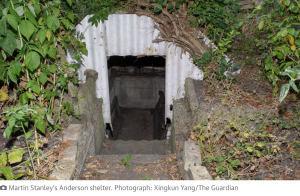
A restored Anderson air-raid shelter, originally covered with soil; source
The bombing of London was focused on the central areas. I vividly remember one noisy night when London’s docklands to our south were heavily bombed with high explosives and then showered with incendiary bombs. The night sky was lit up like day, with fountains of exploding lights as in a monstrous Guy Fawkes (firework) night celebration. Very few bombs landed near us.
A few weeks later, Dad drove us in his little Austin 7 car to see the damage in the City of London. The East End was shattered. The city was largely flattened and St Paul’s Cathedral stood in a field of rubble. It had been saved by a devoted team of firemen and volunteer fire watchers, who had climbed on the roof and dome of the cathedral to throw off the incendiary bombs before they could ignite. I visited the site again at the end of the war. The rubble had been cleared, and St Paul’s stood in glory in a field of open land, just as its architect, Sir Christopher Wren, had intended. Sadly, the area has now been rebuilt in a smother of medium-rise office blocks on the existing, narrow, medieval streets. Today, the cathedral can only be seen when you get quite close.
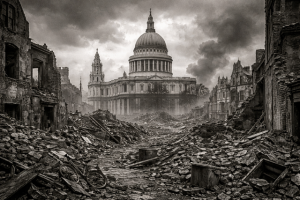
St Paul’s Cathedral standing amid the ruins of the City of London after the Blitz
Throughout the blitz, London Transport buses and underground electric trains continued to operate as usual, connecting with both the national rail network and local bus service timetables. Before the war, an extension of the London underground system of tunnels and stations was under construction at Gants Hill, the suburb of Ilford where we lived. By 1941, the tunnels had been largely converted into underground factories for war work. Local boys, including me, made good use of the dark tunnels by letting off homemade fireworks, thus putting our chemistry classes to good practical use. I have always been fascinated by bonfires and fireworks, a pyromania that I seem to have passed on to most of our grandchildren. A legacy of the war years, perhaps?
**************
My Life in WW2 in Essex
In September 1941, I began my second year at Ilford County High School for Boys, this time back in the prewar buildings. By September 1942, I was in the third form and a 13-year-old teenager. My family now included toddler sister Margaret, with Mum and Dad also expecting a new baby. Our tiny upstairs flat (unit in Australia) was packed with our bodies and furniture! We moved to a dilapidated 5-bedroom Victorian house in the village of Blackmore in rural Essex in May 1943, partly to avoid the London blitz but mainly to give us more living space. I then went to King Edward 6th School in Chelmsford (founded by King Henry 8th’s son in 1551, incidentally) just in time for the bombing of the Chelmsford war factories. For good measure, the Germans dropped incendiary bombs on us at Blackmore, mostly at night, in the mistaken impression that they were hitting Chelmsford. This makes the basis of a good story, and I think I know how this bombing came about.
The Germans had a good strategic reason to bomb Chelmsford. There were three important factories in town that made radio devices, diesel engines and parts for Spitfires. The British obviously had a good reason to try to stop or divert the bombing, using what is now known as misinformation. Chelmsford’s blackout was extremely effective and rigorously enforced. About 20 wooden mini-towers were erected by army construction teams in the Blackmore area. After that, our rural area was bombed night after night. Off-duty soldiers in the pubs were told to tell the locals that the work on the mini-towers was all ‘hush-hush’ and included radio-location devices to warn us of approaching enemy aircraft. They were our new ‘secret weapon’!
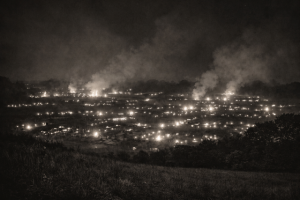
Decoy lighting installations were used to mislead German bombers
My pals and I prowled around one of the towers to have a good look for ourselves. There was no power cable and no way to climb up the tower unless you had a ladder on the ground. The tower had no walls and no floors, it was just a frame of wooden beams bolted together. There was an internal ladder starting about ten feet above the ground, leading up to the top of the tower, perhaps 100 feet (30 metres) high. There seemed to be a level roof of planks at the very top, about ten feet (3 metres) square. There were no fences. Army guards ordered us to keep well away. We had another local air-raid that very same night. My friends and I slipped out of doors and made for a low hill where we had a cubby with a grand view of the night sky. The mini-towers were silhouetted and – surprise, surprise – they shone lights up from their roofs, over an area of similar shape to central Chelmsford. They were decoys! So Chelmsford’s bombs came whizzing down on us. Mystery solved.
Bombing continued for several weeks and the Luftwaffe trialed their own new secret weapon on us. It was a giant bomb casing made in two sections hooked together and slung below an attacking aircraft. The rear section had rudders in the tail. The forward section had an immobilised propeller in the nose. The bomb casing was filled with 1000 incendiary bombs weighing about one kilogram each, some with a pointed nose and some flat. When the giant bomb was released over the target (us), the propeller was allowed to rotate freely. This caused the bomb to topple upside down. The two halves of the casing then fell apart and incendiary bombs were scattered over an area about 500 metres (or yards) across. The bomb site was lit up in an impressive fireworks display when the incendiaries exploded.
Early in the morning, we kids scoured the bomb site and hid any unexploded incendiaries in a ditch. We were careful to leave alone any bombs with pointed noses because the police had warned us that they were armed with an explosive charge that could blow us to bits. When the air-raid wardens had completed their rounds and taken away all the unexploded devices that they could find, then we went back to retrieve our loot. We unscrewed the flat ends of the incendiaries with the aid of my father’s spanners and vice and then tipped the contents into a bucket to be made into our own home-made fireworks. The casings were of a highly flammable magnesium-aluminium alloy. We stored our casings in rabbit holes in the orchard to liven up a bonfire at a later date. My step-father made one casing into a weight for my cuckoo clock by filling it with an appropriate weight of sand. The clock kept very good time, and we displayed it on the kitchen wall. A few days later, a warden called at our house, just to check that we were alright. He spotted the clock and promptly confiscated the weight as a fire hazard. Spoil sport!
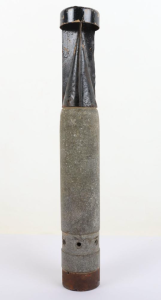
Unexploded incendiary bomb; source
Now for an example of our experiences in a kind of reverse blitz, when our side was plastering bombs on Germany somewhat later in the war. The US Eighth Army Air Force built bases in eastern England for daylight raids on Germany. American losses of planes and fliers were very high, and not always due to enemy action. One Marauder B26 medium bomber took off from the base near us, but the plane was too heavily laden to gain altitude. It crashed in the field immediately behind our house. Obviously, the bombs did not go off on impact, otherwise I would not be here to tell the tale. The military meat wagon (ambulance) removed the casualties right away, but it was several days before the wreckage was cleared. My friends and I collected broken belts of ammo and other treasures to add to our collection. Teenagers were not overly squeamish about the horrors of war.
**************
My Life in WW2 with the Doodlebugs
Doodlebugs, also called buzz bombs by the Allies, were labelled V1 (standing for ‘vengeance weapon no. 1’) by the Germans. They were first fired at England in 1943 sometime before D Day on 6th June 1944, when the Allies landed in Normandy. They were the very first flying bombs and Hitler’s special secret weapon designed to win the war quickly. They were unmanned aircraft, each carrying a ton of high explosive that exploded on impact. There was a jet engine bolted on top of the fuselage. They were cheap to build. They flew at over 300 mph (500 km/h) on a straight course, at about 500 feet (150 m) altitude. Their trajectory was pre-set by controllers on the ground, with about 4000 V1s being aimed at London. Most flew inland over Kent or Sussex, too low to be hit by ack-ack fire.
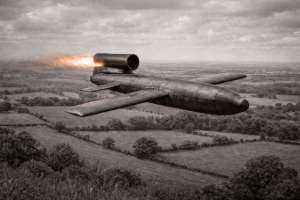
A German V1 flying bomb, or “doodlebug”
All available barrage balloons were hurriedly re-sited south of London. The balloons were large and tethered to the ground by steel cables, creating a physical hazard that brought down a few doodlebugs. Spitfires and Hurricanes were the only allied fighter planes in service at the time that were fast enough to intercept the V1s. If they got close enough to fire their machine guns they could shoot them down, but the subsequent explosion in the air usually brought down the fighter plane as well. The only tactic found to work was to fly alongside the flying bomb and nudge it off course with the fighter’s wing tip. This became standard practice, and while Londoners were protected in this way, there was massive property damage to the south of London.
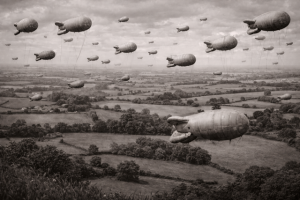
Barrage balloons were used disrupt the flight paths of incoming V1 flying bombs
After the liberation of France and Belgium (following D Day), the V1 launch sites were moved to the Netherlands. Now, the doodlebugs aimed at London flew in over us in Essex. We saw or heard them at all hours of the day or night: when we were cycling to school, feeding the hens, in the bath, going to bed. Teenagers of course believe that they are indestructible, but Mum and Dad prudently moved their bed downstairs, with the babies’ cots tucked behind protective walls in the temporary bedroom. I stayed upstairs where I could get a better view from my bedroom window. I became an avid watcher of doodlebugs. Their jet sounded like a motorbike engine that was without a silencer and was badly out of tune. When a pilotless plane came into view, you could see its flames flaring behind. As long as the bug kept going, you were safe, but if the light went out and the noise stopped suddenly, the police advised you to dive under the bed. (I never needed to, as it happened!) If you heard the drone stop in the far distance, there was a pause for several seconds, then a distant thud when the bomb landed and exploded. The blitz from conventional bombers occurred mainly at night, but attacks by V1s were at all hours and were unpredictable.
**************
My Life in WW2 with the V2 rockets
The second German vengeance weapon was known by friend and foe alike as the V2. It was a rocket developed and tested by army engineers over several years in north Germany. The test launches were fired eastwards over the Baltic Sea. The range and accuracy of the V2 were monitored from several sites, including one in occupied Denmark by a rocket engineer with a wife in Munich. He used to correspond with his wife regularly by radio, using the German ‘Enigma’ military code. The engineer and his wife had developed their own private system unknown to the German authorities, so they could correspond in private about their personal news. Naturally, their transmissions were received by the German military authorities, but the British had already ‘cracked’ the Enigma code. This was a closely guarded war secret by the Allies. My mother’s youngest sister Myrtle volunteered for the ATS (British women’s army) in 1940 and was trained as a wireless operator. She was assigned to record all the radio transmissions from and to the V2 rocket engineer stationed in Denmark. How do I know all this? Well in 1990, Myrtle was released from the UK Official Secrets Act and was allowed to tell the family what she did in the war.
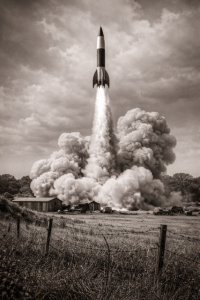
The German V2 rocket — the world’s first long-range ballistic missile
The first V2s that landed in London were launched from Holland in September 1944. They were the prototype for all the American and Russian military rockets and space rockets that followed. They carried a ton of high explosive that travelled through the stratosphere at 5000 km/hour. They arrived without warning. Unlike the VIs, their fuses were delayed to explode underground, so no air-raid shelter was safe from them. We heard later that V2s had a far greater psychological impact on Londoners than V1s or any conventional bombing in the blitz. After the war, we were told that MI5 (a British secret service agency) had caught half a dozen spies working for the Germans in the London area. They had been ‘turned’, so that they then worked for us rather than for the enemy. The role of the spies was to report to the Germans where the V2s had landed. This tricked the enemy engineers into aiming the V2s too far to the south and west. So, most of the later bombs landed in countryside spread to the north and east of London, and we copped it instead of Londoners.
The nearest one to us overshot us by perhaps a kilometre (half a mile). It landed at seven o’clock in the morning, just as I was getting ready to bike to the school bus. We heard a whistle for perhaps half a second, then a terrific bang. My sister Margaret was about two years old. She was sitting in an armchair under the kitchen window. She was showered with shards of broken glass but did not even get a scratch. I helped Mum pick up the bits. When I biked home from school that day, the window had already been repaired with a large sheet of wartime plastic. That was the only war damage we personally suffered in the entire war. We were so very fortunate compared with other families we knew.
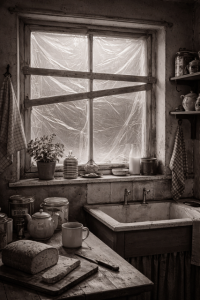
A wartime home with windows repaired using plastic sheeting after blast damage